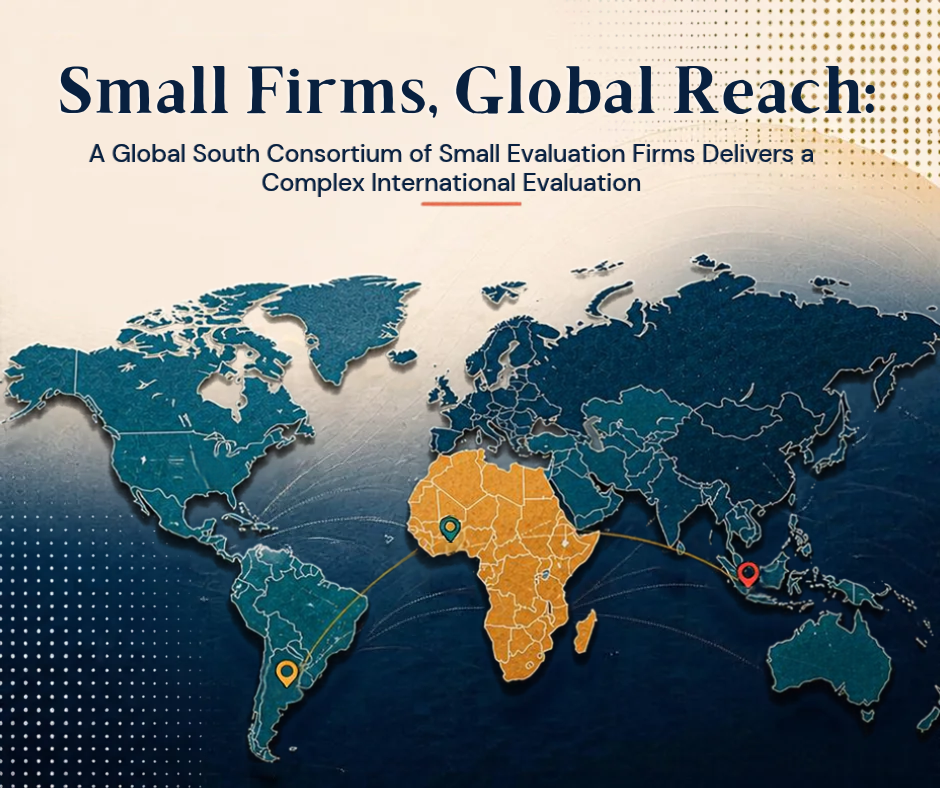
Small Firms, Global Reach: A Global South Consortium of Small Evaluation Firms Delivers a Complex International Evaluation
How Asuntos del Sur, Dala Institute and the Institute for Peace and Development combined regional knowledge, technical expertise and collaborative leadership to evaluate the client’s programs.
A First-Time Consortium with a Shared Ambition
Between April 2025 and July 2026, three small evaluation firms rooted in the Global South came together for the first time to undertake a highly complex, multi-continent and multi-country evaluation of a client’s programs. The consortium brought together Asuntos del Sur in Argentina, Dala Institute in Indonesia, and the Institute for Peace and Development (IPD) in Tamale, Ghana. Although the firms were geographically dispersed and had not previously worked together as a consortium, they built an effective partnership around a common commitment: to deliver rigorous, context-sensitive and globally coordinated evaluation work.
One Evaluation, Three Regions, Many Perspectives
The client’s programs covered multiple countries, thematic areas, and partners. Interventions that program partners undertook ranged from the promotion of gender equality and green jobs, strengthening low-carbon policies, building evidence for climate-smart smallholder agricultural and livelihood systems and enterprises, and the advancement of circular economy solutions through digital innovation, capacity-building, and improved resource efficiency, among others. The assignment therefore required the consortium to work across Africa, Asia and Latin America, bringing on board different thematic experts to engage multiple partners and projects of the client for interviews and other evidence-gathering processes. This breadth was not simply a matter of covering more locations. It required the team to work across different languages, time zones, institutional settings and diverse economic and social contexts while maintaining a coherent evaluation framework. The consortium had to combine globally consistent and rigorous methods with the flexibility needed to understand how the program operated in different regions.
IPD’s Role: Coordinating Africa and Co-Leading Globally
IPD played a central role in making this complex arrangement work. While co-leading the overall design and implementation of the assignment with its consortium partners, IPD coordinated the evaluation across multiple African countries. From its base in Tamale, the Institute helped translate the global evaluation design into workable country-level processes, supported consistent data collection, and maintained communication across teams and contexts.
A major part of this contribution was IPD’s ability to recruit, coordinate and successfully manage independent evaluators and technical experts drawn from academia and the wider evaluation field in Burkina Faso, Ghana, Kenya and Senegal. Bringing together professionals with different disciplinary, national and institutional backgrounds demanded clear roles, dependable systems and responsive leadership. IPD’s management helped ensure that country-level insights were captured without losing alignment with the consortium’s shared questions, quality standards and timelines.
The Importance of Being Given the Opportunity
The client deserves credit for taking a chance on this first-time consortium. By entrusting a demanding global assignment to three relatively small firms based in the Global South, the client created space for the exhibition of leadership capacities of small firms that is too often overlooked in recruitment processes for international evaluation assignments. The client’s decision recognized that organizational size and location are not substitutes for competence. It also allowed firms with deep regional knowledge and strong local networks to shape the evaluation rather than serving only as data collectors within consortium a model designed and directed from elsewhere.
A Practical Case for Global South Evaluation Leadership
The successful completion of the assignment shows what becomes possible when small evaluation firms are judged by the quality of their ideas, networks, expertise and systems rather than by scale and location alone. Asuntos del Sur, Dala Institute and IPD demonstrated that Global South firms can collaborate across continents, manage complex teams, engage partners in multiple regions and deliver quality and timely evaluation work at par with larger international firms. Their experience offers a practical model for a more inclusive evaluation sector—one in which Global South organizations are not merely consulted, or used as subsidiary data collectors, but are trusted to lead.
The lesson is straightforward: capability to conduct rigorous evaluation is widely distributed, but opportunity is not. When commissioners create room for credible, locally grounded firms to lead, small organizations can bring regional depth, access to networks, methodological rigor and global coordination together—and deliver successfully at international scale.